



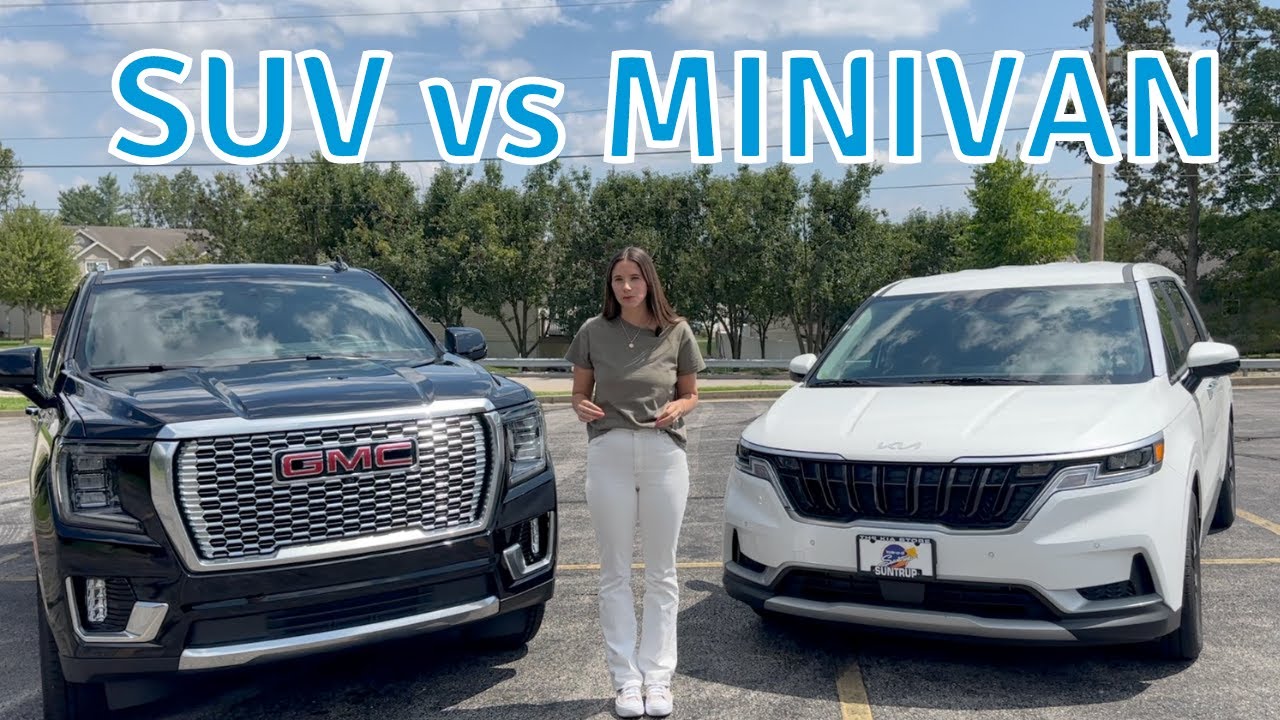
Every parent eventually reaches the crossroads where their reliable compact sedan or midsize crossover simply runs out of room. Maybe it happens after bringing home baby number two, when a rear-facing infant seat turns the front passenger seat into an instrument of knee torture. Maybe it happens when the gear for youth soccer, a double stroller, and a week’s worth of groceries need to occupy the exact same square footage.
When you need three rows of seating, the automotive market divides sharply into two camps: the unapologetic utility of the minivan and the rugged, aspirational aesthetic of the three-row SUV.
Choosing between them is rarely just about horsepower or spec sheets. For many drivers, it feels like an existential battle between aesthetic dignity and ruthless everyday convenience. Yet, when you strip away the marketing gloss and look at how families actually live in their vehicles, the debate becomes far more nuanced.
The Cultural Stigma vs. Packaging Reality
The minivan has spent decades fighting an unfair branding war. In American car culture, opting into a sliding-door van has long been treated as the ultimate surrender to suburban domesticity. Automakers recognized this psychological hurdle twenty years ago and answered it with the modern three-row crossover: a vehicle offering roughly the same number of seatbelts wrapped in the aggressive sheet metal, raised ride height, and all-weather bravado of an off-roader.
Under the skin, however, these vehicles are engineered around fundamentally different priorities.
A minivan is designed from the inside out. Engineers start with the human beings and cargo that need to fit, sculpting the cabin to maximize internal volume before wrapping exterior panels around that space. The result is a monovolume shape that extracts every cubic inch of usable room from its exterior footprint.
Most three-row SUVs, by comparison, are styled from the outside in. Long hoods, high beltlines, raked rooflines, and sculpted wheel arches look handsome in the driveway, but they consume valuable space that could otherwise go to legroom, headroom, and cargo depth. Deciding between them begins with recognizing whether you are buying a vehicle for how it makes you look to the outside world, or how it makes your life feel inside the cabin.
Everyday Usability: The Physics of Sliding Doors and Low Floors
Ask any seasoned parent who made the switch to a minivan what feature they would defend to the death, and the answer is almost always the same: power-sliding side doors.
In an era where parking spaces feel increasingly narrow and modern vehicles continue to grow wider, traditional hinged SUV doors are an operational hazard. Reaching into a second row to buckle a squirming toddler while contorting your body to keep your door from slamming into the neighboring luxury sedan requires athletic flexibility. Power sliding doors eliminate that anxiety entirely. With the touch of a key fob or a kick under the rocker panel, the door glides open along the vehicle body, granting an expansive, unrestricted portal into the cabin.
Equally transformative is the step-in and load-in height. Minivans are built on low passenger-car chassis architectures. Their floors typically sit between 16 and 18 inches off the pavement. This lower floor allows toddlers to climb into their seats unassisted, spares aging grandparents from having to hoist themselves up into a high cabin, and prevents dogs from straining their joints during entry.
By contrast, midsize and full-size three-row SUVs sit on elevated suspension setups designed to provide between seven and nine inches of ground clearance. While that clearance proves valuable when tackling a rutted trail or navigating a blizzard, it creates a daily lifting penalty. Hoisting a 30-pound double stroller, heavy coolers, or bulky travel luggage over a high SUV bumper quickly becomes an exhausting chore. In a minivan, the trunk lip sits barely knee-high, meaning you slide heavy gear in rather than lifting it over a precipice.
The Car Seat Dilemma and Third-Row Accessibility
Automakers love to advertise eight-passenger capacity in their three-row SUVs, but the reality of third-row access in modern crossovers reveals major packaging compromises.
Installing child safety seats is where the battle lines become most distinct. If you have two kids in child seats placed in the second-row captain’s chairs or outboard positions of an SUV, accessing the third row often turns into a logistical puzzle. Many SUV tilt-and-slide mechanisms cannot operate when a child seat is firmly anchored in place. Unless the vehicle has a pass-through aisle between captain’s chairs, getting an older child, teen, or adult into the third row requires sending them on an awkward crawl over seatbacks or through the trunk.
Minivans solve this problem through interior ingenuity. Several modern vans offer track systems that allow the second-row seats to slide forward, backward, and laterally toward each other. This lateral movement creates a generous walk-through alley to the back row even with large, bulky car seats securely latched in place.
Furthermore, the third row of a minivan is actually built for adult bodies. Because the rear floor is sunken, third-row passengers sit with their thighs naturally supported rather than with their knees forced upward toward their chests. Legroom in the rearmost seats of a minivan routinely exceeds 36 inches, whereas midsize SUVs often relegate back-row riders to cramped perches reserved strictly for emergency trips or small children.
Cargo Capacity: What the Spec Sheets Hide
Cargo volume figures can be deceiving if you only look at total numbers with all seats folded flat. When traveling with a family of five, six, or seven, folding down the rear seats is not an option. What matters most is usable cargo volume behind the third row.
This is where the minivan delivers an absolute rout against virtually every three-row crossover on the market. Behind their upright third-row seats, minivans feature a deep, cavernous well that typically swallows 32 to 38 cubic feet of cargo. That deep recess easily accommodates a full-sized multi-kid stroller standing upright, along with several rolling suitcases, sports bags, and grocery totes.
Most three-row midsize crossovers offer only 15 to 22 cubic feet of space behind their third rows. Because their floors must sit above rear differentials, driveshafts, or spare tire mounts, the cargo deck is completely flat and shallow. Pack a single large stroller into the back of an SUV, and you will often find yourself stacking luggage precariously close to the rear glass, risking items tumbling out the moment you open the liftgate.
To match the behind-the-third-row cargo capacity of an ordinary minivan, an SUV buyer must step up to an extended-wheelbase, full-size, truck-based SUV. However, moving to an extended full-size vehicle drastically increases the price tag, compromises fuel efficiency, and makes parallel parking or maneuvering tight parking garages an exercise in stress.
Where the 3-Row SUV Earns Its Crown
Given the clear packaging and practical advantages of the minivan, it is fair to ask why three-row SUVs continue to dominate sales charts. The answer is that SUVs provide genuine mechanical capabilities that minivans simply cannot replicate.
Towing Muscle and True All-Weather Capability
If your family’s recreation involves pulling a travel trailer, a boat, horse trailers, or heavy toy haulers, the minivan immediately hits a hard ceiling. Nearly every minivan on the market maxes out at a towing capacity of 3,500 to 3,600 pounds. That is enough for a small pop-up camper or a pair of jet skis, but inadequate for anything larger.
Three-row midsize SUVs comfortably tow between 5,000 and 6,000 pounds, while full-size body-on-frame SUVs can haul 7,000 to 9,000 pounds without breaking a sweat. For families who tow heavy recreational toys, the debate ends right here: an SUV is a non-negotiable necessity.
Additionally, while several minivans offer capable all-wheel-drive systems engineered to provide stability on rain-slicked roads or light snow, they lack the ground clearance and suspension articulation required for anything beyond paved surfaces. A three-row SUV equipped with a true multi-mode terrain management system, higher clearance, and protective underbody shielding gives drivers the confidence to traverse fire roads, snowdrifts, and unpaved national park trails without scraping undercarriage components.
Market Variety, Styling, and Resale Longevity
The minivan market has consolidated down to a tiny handful of choices. If you want a brand-new van, your options are limited to four models.
By contrast, the three-row SUV segment is the most fiercely contested battleground in the automotive industry. Buyers can choose from dozens of distinct models spanning every conceivable aesthetic, from sleek urban designs to boxy, trail-ready cruisers. You can select sporty turbocharged powertrains, serene luxury cabins, rugged off-road trim packages, or fully electric architectures.
That massive consumer demand also translates to the used market. Three-row SUVs tend to retain a broader base of prospective buyers over time, as their appeal extends well beyond parents with young children, helping sustain strong resale value when it comes time to trade in.
The Efficiency Equation: Real-World Operating Costs
Family life comes with endless expenses, making total cost of ownership a vital factor in any vehicle purchase. When evaluating recurring costs like fuel, insurance, and routine maintenance, minivans frequently emerge as the more economical long-term investment.
Hybrid powertrains have redefined the efficiency conversation. Certain modern minivans feature hybrid systems as standard equipment, routinely achieving 36 miles per gallon combined. Even standard V6 minivans reliably average in the low-to-mid 20s.
In the SUV realm, matching that kind of fuel economy requires seeking out specific hybrid trims that often carry premium purchase prices and long dealer waitlists. Non-hybrid midsize SUVs rarely exceed 20 to 23 mpg in combined driving, and full-size truck-based V8s frequently struggle to maintain 16 mpg in suburban stop-and-go commuting. Over a typical five-year ownership cycle covering 75,000 miles, the difference in fuel costs between an efficient minivan and a thirsty large SUV easily amounts to thousands of dollars saved.
Furthermore, minivans run on standard-size passenger vehicle tires and utilize proven mechanical platforms that keep routine suspension, brake, and tire replacement costs reasonable. Large SUVs, equipped with heavy 20-inch or 21-inch wheel setups, stiffer truck suspensions, and complex four-wheel-drive transfer cases, typically incur higher ownership and maintenance expenses over their lifespan.
Choosing Your Family’s Champion: The Litmus Test
Deciding between these two vehicle classes comes down to an honest assessment of your family’s daily habits and physical stage of life.
Choose a minivan if:
-
You have two or more children in car seats or booster seats.
-
You prioritize easy carpool pickup lines, stress-free parking lot maneuvers, and zero door dings.
-
You need deep trunk space that can hold an enormous stroller and vacation gear simultaneously.
-
Maximizing passenger comfort and everyday boarding speed matters more than vehicle styling.
-
You want lower fuel bills and accessible vehicle entry for kids and grandparents alike.
Choose a 3-row SUV if:
-
You regularly tow trailers, boats, or campers weighing more than 3,500 pounds.
-
You live at the end of an unpaved road, in regions with heavy snowfall, or regularly camp off the grid.
-
Your children are past the bulky car seat stage and can comfortably climb into a higher vehicle.
-
You value personal driving dynamics, an elevated road view, and an exterior profile that feels active and stylish.
-
You prefer having dozens of trim choices, powertrain varieties, and styling packages to pick from.
At its core, a minivan is a dedicated tool engineered to solve the specific daily challenges of family transportation with effortless grace. A three-row SUV is a versatile lifestyle vehicle designed to balance good passenger space with adventure-ready capabilities and commanding road presence.
If you view your vehicle strictly as an appliance to make parenting easier, the minivan remains undefeated. But if your family’s lifestyle actively demands rugged terrain capability, heavy towing muscle, or simply a profile that looks right at home off the beaten path, the modern three-row SUV proves that you do not have to abandon utility to drive something you genuinely love.